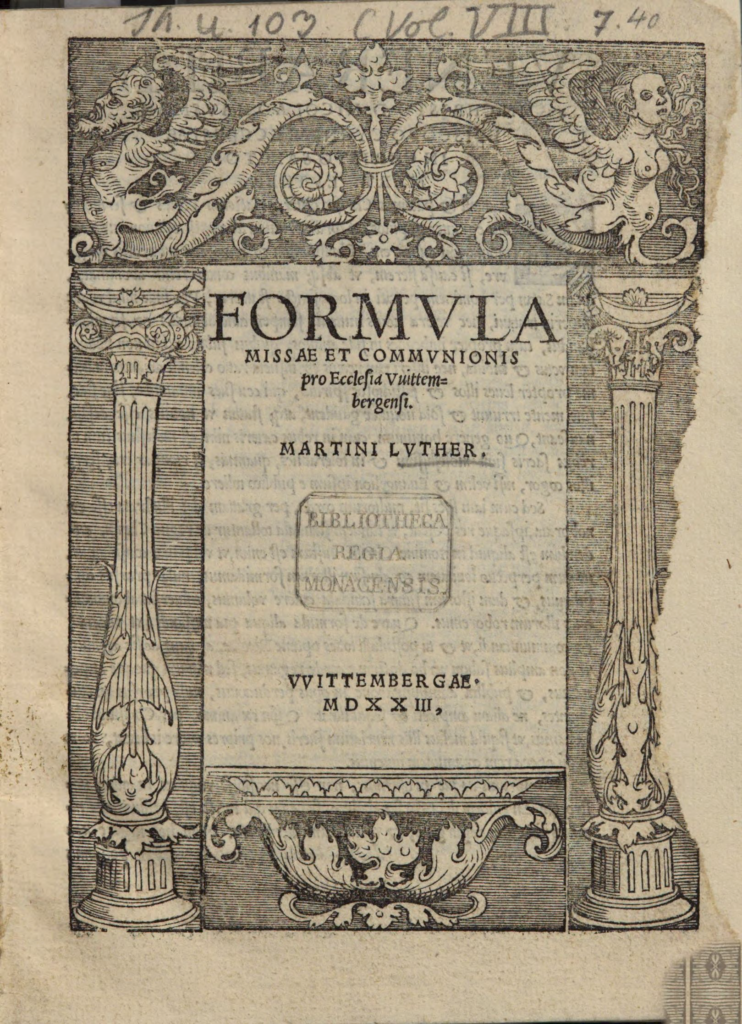
The section at the end of the Formula Missae et Communionis in which Luther calls for ‘cantica vernacula plurima’. Below the image, the transcription with English Translation.
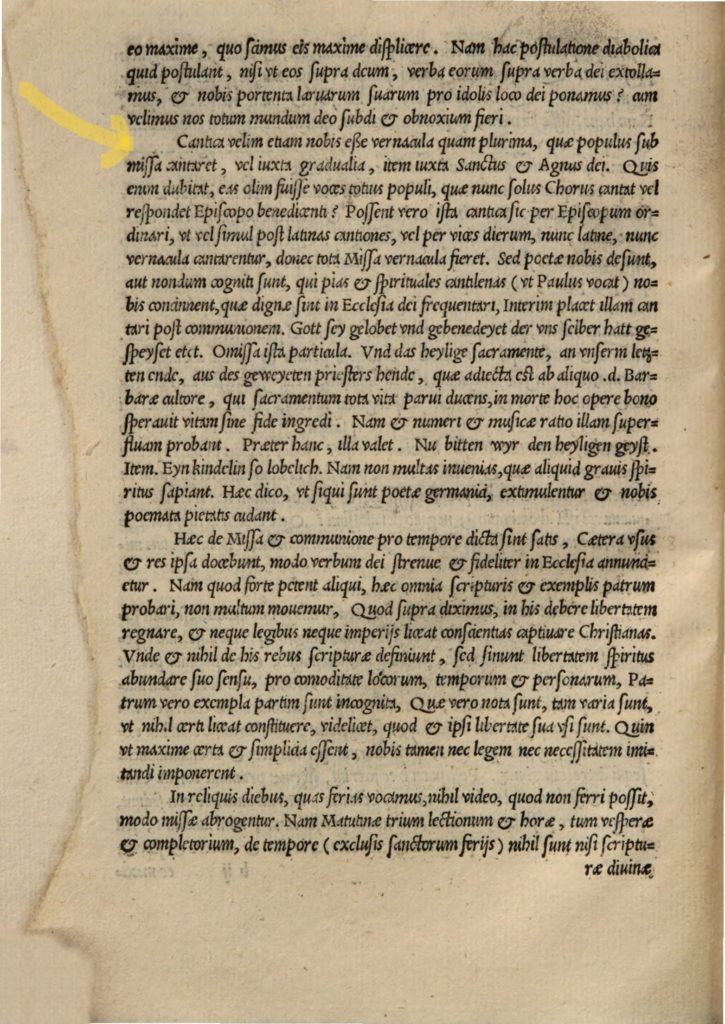
| Cantica velim etiam nobis esse vernacula quam plurima, quae populus sub missa cantaret, vel iuxta gradualia, item iuxta Sanctus et Agnus dei. Quis enim dubitat, eas olim fuisse voces totius populi, quae nunc solus Chorus cantat vel respondet Episcopo benedicenti? Possent verò ista cantica sic per Episcopum ordinari, vt vel simul post latinas cantiones, vel per vices dierum, nunc latine, nunc vernacula cantarentur, donec tota Missa vernacula fieret. Sed poetae nobis desunt, aut nondum cogniti sunt, qui pias et spirituales cantilenas (vt Paulus vocat) nobis concinnent, quae dignae sint in Ecclesia dei frequentari, Interim placet illam cantari post communionem. Gott sey gelobet vnd gebenedeyet der vns selber hatt gespeyset etct. Omissa ista particula. Vnd das heylige sacramente, an vnserm letzten ende, aus des geweyeten priesters hende, quae adiecta est ab aliquo .d. Barbarae cultore, qui sacramentum tota vita parui ducens, in morte hoc opere bono sperauit vitam sine fide ingredi. Nam et numeri et musicae ratio illam superfluam probant. Praeter hanc, illa valet. Nu bitten wyr den heyligen geyst. Item. Eyn kindelin so lobelich. Nam non multas inuenias, quae aliquid grauis spiritus sapiant. Haec dico, vt siqui sunt poetae germanici, extimulentur et nobis poemata pietatis cudant. Haec de Missa et Communione pro tempore dicta sint satis; Caetera vsus et res ipsa docebunt, modo verbum dei strenue et fideliter in Ecclesia annuncietur. | I would also wish for us to have as many songs/hymns in the vernacular as possible, which the people might sing during the Mass, either alongside the graduals, or likewise alongside the Sanctus and Agnus Dei. For who doubts that those voices, which now only the Choir sings or uses to respond to the blessing Bishop, were once the voices of the entire congregation? These hymns/songs could be so arranged by the Bishop that they are sung either immediately after the Latin chants, or by alternating days—now in Latin, now in the vernacular—until the entire Mass should become vernacular. But we lack poets, or they are not yet known to us, who might compose for us pious and spiritual songs (as Paul calls them) which are worthy of being used frequently in the Church of God. In the meantime, it is pleasing that the following be sung after communion: Gott sey gelobet vnd gebenedeyet der vns selber hatt gespeyset (“God be praised and blessed, who has himself fed us”), etc.—omitting that one specific part: Vnd das heylige sacramente, an vnserm letzten ende, aus des geweyeten priesters hende (“And the holy sacrament, at our final end, from the consecrated priest’s hands”), which was added by some devotee of St. Barbara. He, having thought little of the sacrament during his whole life, hoped by this “good work” to enter into life at death without faith. Indeed, both the meter and the musical structure prove that part to be superfluous. In addition to this one, that other is useful: Nu bitten wyr den heyligen geyst (“Now we pray to the Holy Spirit”). Also: Eyn kindelin so lobelich (“A child so lovely”). For you will not find many that savour of a truly grave or serious spirit. I say this so that if there are any German poets, they may be stimulated to forge for us poems of piety. Let these things said about the Mass and Communion for the time being suffice; usage (= practice) and the matter itself (= the reality of what we celebrate) will teach the rest, provided that the word of God is vigorously and faithfully proclaimed in the Church. |