QVAESTIO CVII
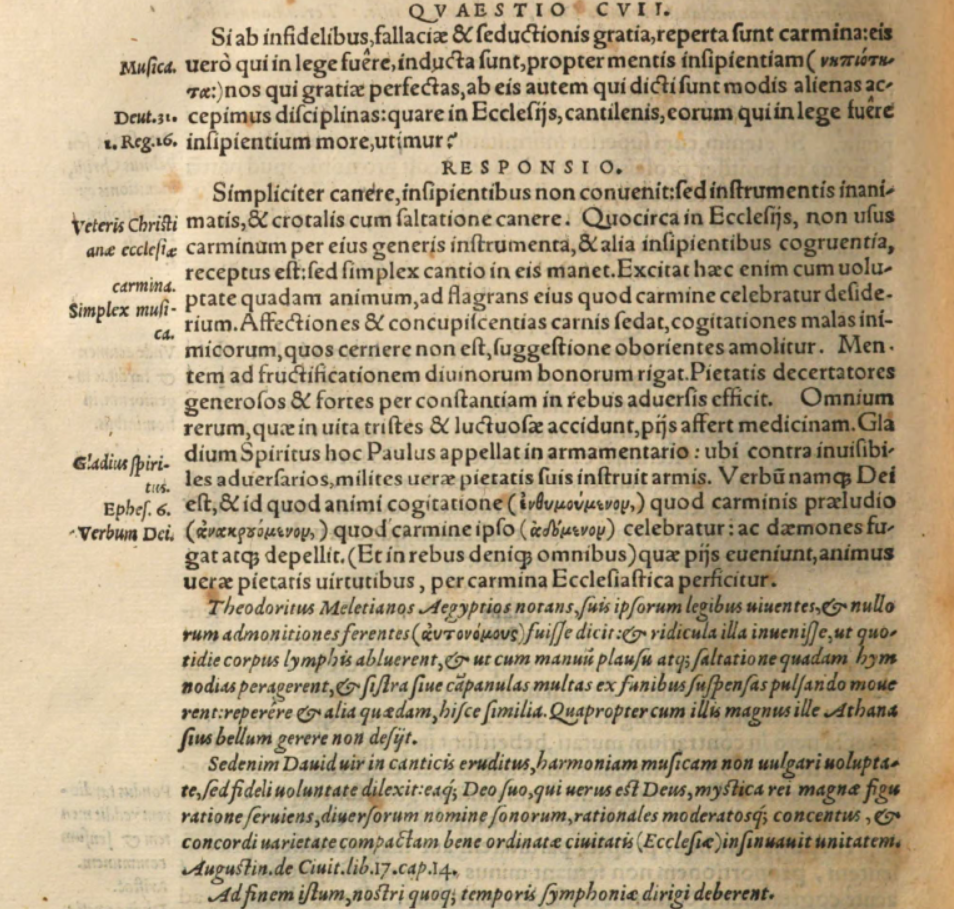
Si ab infidelibus, fallaciae & seductionis gratia, reperta sunt carmina: eis vero qui in lege fuere, inducta sunt, propter mentis insipientiam (νηπιότητα): nos qui gratiae perfectas, ab eis autem qui dicti sunt modis alienas accepimus disciplinas: quare in Ecclesiis, cantilenis, eorum qui in lege fuere insipientium more, utimur? [in margine: Musica, Deut. 31, 2Reg (Samuel) 16]
RESPONSIO
Simpliciter canere, insipientibus non convenit: sed instrumentis inanimatis, & crotalis cum saltatione canere. Quocirca in Ecclesiis, non usus carminum per eius generis instrumenta, & alia insipientibus congruentia, receptus est: sed simplex cantio in eis manet. [in margine: Veteris christianae ecclesiae, carmina. simplex musica.]
Excitat haec enim cum voluptate quadam animum, ad flagrans eius quod carmine celebratur desiderium. Affectiones & concupiscentias carnis sedat, cogitationes malas inimicorum, quos cernere non est, suggestione oborientes amolitur. Mentem ad fructificationem divinorum bonorum rigat. Pietatis decertatores generosos & fortes per constantiam in rebus adversis efficit. Omnium rerum, quae in vita tristes & luctuosae accidunt, piis affert medicinam. Gladium Spiritus hoc Paulus appellat in armamentario: ubi contra invisibiles adversarios, milites verae pietatis suis instruit armis. [in margine: Gladius Spiritus. Eph. 6. Verum Dei] Verbum namque Dei est, & id quod animi cogitatione (ἐνθυμούμενομ), quod carminis praeludio (ἀνακρυόμενου), quod carmine ipso (ἀδόμενομ) celebratur: ac daemones fugat ac depellit. Et in rebus denique omnibus quae piis eveniunt, animus verae pietatis virtutibus, per carmina Ecclesiastica perficitur.
CATENA
Theodoritus Meletianos Aegyprios notans, suis ipsorum legibus viventes, nullorum admonitiones ferentes (αὐτονόμους) fuisse dicit: ridicula illa invenisse, ut quotidie corpus lymphis abluerent, ut cum manuum plausu atque saltatione quadam hymnodias peragerent, sistra sive campanulas multas ex funibus suspensas pulsando moverent: reperere alia quaedam, hisce similia. Quapropter cum illis magnus ille Athanasius bellum gerere non desiit.
Sed enim David vir in canticis eruditus, harmoniam musicam non vulgari voluptate, sed fideli voluntate dilexit: eaque Deo suo, qui verus est Deus, mystica vel magna figuratione serviens, diversorum nomine sonorum, rationales moderatosque concentus, concordi varietate compactam bene ordinatae civitatis (Ecclesiae) insinuavit unitatem.
Ad finem istum, nostri quoque temporis symphoniae dirigi deberent.
Remarks
What nobody sees, unless one knows already, is that Lange has switched the position of the last two participles. Original order: ᾀδόμενον (adomenon – “that which is sung”), followed by ἀνακρουόμενον (anakrouomenon – what is struck). Since he opted for the translation that hervorhebt the ‘beginning’ of the musical act) and since he can not accept that it could be instrumental, he suddenly was exposed to a logical problem: why was ‘singing’ first, and followed by ‘beginning to sing – strike a song’. To solve this selfinflicted problem , he switched position. First ἀνακρουόμενον then ᾀδόμενον: first ‘intonation’ then ‘singing’. Fr. Sylburg in 1593, although editing and publishing the Greek texst correctly, does not flag it. He maintains the translation, incl. the order.
- νηπιότητα (nēpiotēta), meaning “infancy” or “spiritual/mental childishness.”
- ἐνθυμούμενον (enthymoumenon – “that which is meditated upon”) and ᾀδόμενον (adomenon – “that which is sung”). ἀνακρουόμενον (anakrouomenon – “that which is struck up / as a prelude”).
- αὐτονόμους (autonomous), directly glossing the Latin phrase suis ipsorum legibus viventes (“living by their own laws”).
- ex funibus: Characteristic term from the Meletian controversy: cords/ropes, describing bells or musical elements suspended from ropes.
English Translation
QUESTION 107
If songs were invented by infidels for the sake of deceit and seduction, but were introduced to those under the Law because of the childish immaturity of their minds (νηπιότητα); and we, on the other hand, have received the perfect teachings of grace—teachings entirely foreign to the aforementioned ways—why do we employ chants in the churches after the manner of those childish ones who were under the Law?
ANSWER
Plain singing is not what is suited to the childish, but rather singing with inanimate instruments, rattles, and dancing. Therefore, the use of songs accompanied by instruments of that kind, and other things suitable for the immature, has not been adopted by the churches; instead, simple chanting remains in them.
For this simple chanting rouses the soul with a certain pleasure toward a burning desire for that which is celebrated in the song. It soothes the passions and desires of the flesh; it drives away evil thoughts that arise through the suggestion of invisible enemies. It waters the mind for the bearing of fruit of divine blessings. It renders the noble and brave champions of piety steadfast in adversity. It brings medicine to the pious for all sad and sorrowful things that happen in life.
This is what Paul calls the “Sword of the Spirit” in the armory, where he equips the soldiers of true piety with his weapons against invisible adversaries. For it is the Word of God—both that which is celebrated by the meditation of the mind (ἐνθυμούμενον), by the prelude of the song (ἀνακρουόμενον), and by the song itself (ᾀδόμενον)—and it puts to flight and drives away demons. And finally, in all circumstances that befall the pious, the soul is perfected in the virtues of true piety through ecclesiastical songs.
CATENA
Theodoret, censuring the Meletian Egyptians, says that they lived by their own laws and would accept no one’s admonitions (autonomous). He notes that they invented ridiculous practices, such as washing their bodies daily with water, performing chants with the clapping of hands and a kind of dancing, and shaking many sistra or little bells suspended from ropes by striking them; they also invented other things similar to these. For this reason, the great Athanasius never ceased to wage war against them.
For David was a man skilled in songs, who loved musical harmony not for vulgar pleasure, but with a faithful will; and by it he served his God, who is the true God, in a mystical prefiguration of a great matter. By means of diverse sounds, he introduced rational and moderated harmonies, showcasing the unity of a well-ordered city (the Church) joined together in harmonious variety. [Augustine, The City of God, XVII.14]
To this same end, the musical harmonies of our own time ought also to be directed.